Whenever I’ve done one of those personality type things, I’ve always come back as the type of person who works in fits and starts. Periods of intense working have always been followed by periods of intense—I don’t know. Not working.
What this means in practice is that slow and steady progress towards goals has always been a bit of a struggle for me. I would have a lot of energy around some project or something, work super hard on it, and then lose focus and let it drop for a while. Then, a deadline would approach, and I’d start working frantically again, stressed out of my mind and sometimes letting balls drop.
The corollary to this personality trait of mine has always been that it would be accompanied by lots of negative internal monologue about working. I would feel myself starting to slip, and then my brain would start actively seizing on thoughts about what a loser I was, and how nobody could possibly have any professional respect for me, and why are you always failing?
In the last year or so, it’s become really clear to me that these two big things were really just two sides of the same coin. Or, maybe more accurately, two phases in an endlessly repeating cycle. Fail at something, feel bad, fail again—rinse, wash, repeat. The fact that I’ve managed to be a basically functioning adult in the midst of this cycle is, I think, pretty amazing. But it’s certainly not enjoyable.
So for the goals I set for myself this year, I wanted to do something different. That’s why I invented a game.
About the Game
When it comes down to it, this game is really just a behavior chart. I got the idea from reading the parenting work of Alan Kazdin. Essentially, he advocates doing the following for any behavior your child exhibits that you’d like to change:
- Define the positive opposite
- Set up a chart, where you give the kid points for doing that positive opposite that work towards a reward
- Practice, giving points for each practice
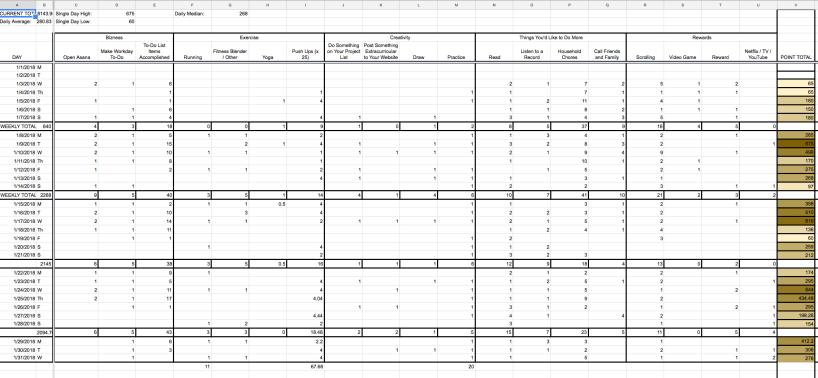
So that’s more or less what I did. I created a spreadsheet where I listed things I’d like to do more (exercise, staying focused and productive at work, practicing guitar), and gave myself points for them. I also listed some activities I’d like to do less (Facebook and other social media, Netflix) and gave myself negative points for them.
Since I like geeky math stuff, I also decided that I ought to give myself bonuses for certain things. Like, each set of 25 push ups was worth 9 points, but that would be multiplied by 4 if I got more than 4 sets in a day. Practicing one day would be worth a certain amount, but practicing multiple days in a row earned a bonus. I also used fancy tools like conditional formatting (the higher the points, the darker the color in the “POINT TOTAL” column) to make it more colorful, and feel more like a game.
The sheet looked like this:
In doing this, there was one super important promise I made to myself: no matter what happened, I would always focus more on the positive than on the negative. This wasn’t about keeping track of my failures, and making myself feel bad for those. This was about noticing successes, and celebrating them.
To me, this last bit was utterly crucial. For reasons mentioned above, I’m pretty inclined to beat up on myself for failure. And if I wanted to break the cycle, I’d have to start changing my attitude towards achievement.
So How Has it Gone?
One super cool thing about keeping track of a game you play every day on a spreadsheet is that you can make it generate neat data. Like, for instance, here is a graph of my daily point totals so far in 2018:
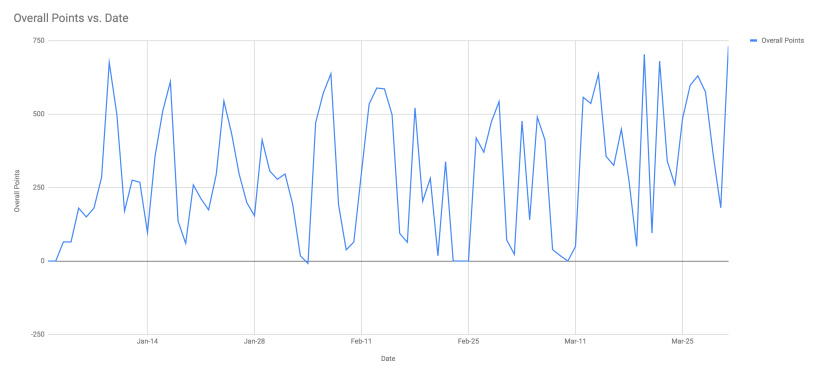
Isn’t that neat? Right there, you can kinda see the “bursts of energy.” Some days are super high, maybe even two or three in a row, but then they’re followed by days that are super low. My score fluctuates pretty hugely from day to day.
So, in a way, doing this hasn’t really changed anything about my daily behavior.
Except for one huge thing. Because I was playing every day, the lows tended not to cluster. A day in which I score zero points is just as likely to be followed by a day in which I score a new personal best as not.
Also, importantly, there is no downward trend in this data, which is something you’d expect out of New Year’s resolution. When I set this up, I anticipated that I’d be lucky to make it to the end of January with this program. But I’ve made it much longer, and I see no signs of slowing down.
One interesting fact that I learned about myself that I didn’t know before came up from one of Google Sheets’ automatically-generated charts:
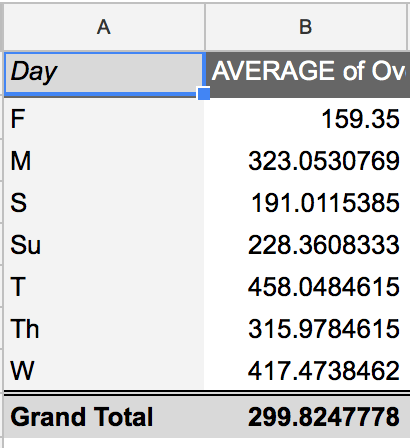
Before Google generated this Pivot Table for me (which, I don’t really know what those are), I had no idea that my highest-scoring day was Tuesday. “Huh, that sure is interesting,” I thought, so I checked to see if that held for other important measures of activities—things like exercise, work productivity, and practicing. Turns out, yup.
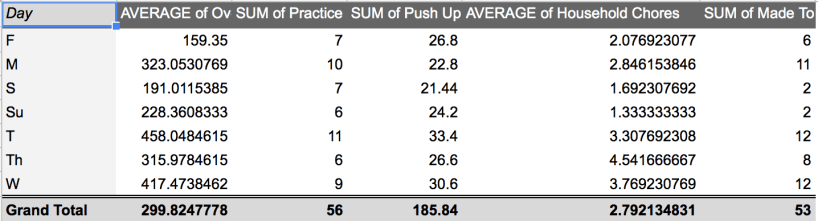
On pretty much everything, Tuesdays were my best day. I was apparently most likely to be focused and on task on Tuesdays. The only exception, as you can see, is household chores, where apparently I put whatever energy I had been putting into other activities into cleaning up around the house. Interesting.
Maybe it isn’t hard to explain this phenomenon: weekends are the time when we don’t have our son in school, so there’s a lot of family time and a lot of socializing. And then Monday is the first day back at work, energy and focus peaks out in the middle, and then declines on its way to the weekend.
I’m not so sure what to do with this information right now. Maybe this means that I need to make sure to buckle down extra hard on Tuesdays, and just start taking Fridays and Saturdays off. Or maybe it needs that I shouldn’t really put much focus on the early part of the week and just try to make my weekends less slack-off-y. I don’t know which would be better.
Thoughts Moving Forward
Whatever the data show above, I have to say I feel really, really great about this system. In so many ways, my life is better than it was before. Since 2018 began, I’ve lost somewhere between 4 and 6 pounds. I am exercising a lot more. And I’m also practicing a lot more. Both of these things have started to yield noticeable results in how I look, how I feel, and how I’m performing as a musician.
This isn’t to say that everything has been bunnies and rainbows: there are whole categories of things I’ve deleted because I just wasn’t doing enough. Drawing, for example, is a thing I’d like to do more but probably not enough to crowd out other fun things. And there definitely have been weeks–particularly when we have family visiting–when it’s been hard to stay focused and on task.
But all the same, the psychological difference I’m experiencing this year is enormous, and worth sharing with others. Even though part of me doubts that any of these things will become habits that I would continue without some sort of reinforcing point chart, I feel so much more in control of my life than I ever have before. And I absolutely love it.
 Marshall Escamilla