Note: To hear the finished version of this track, go to my Bandcamp page!
When you’re working on a project in Logic, the very first decision you have to make is about the tempo and time signature. Since I’ve always been interested in the idea of writing pop music in odd times, this is where I’ll start thinking of ways to make things different. This time, I was thinking of doing something in a compound meter–that is, a meter that divides the beat into three equal parts instead of 2 or 4. And since we’ve all heard a bajillion songs in 3 or 6 or 12, I figured I’d try something at least a little less common. Thus, a meter with 3 compound beats–or 9 total beats in the measure.

For those of you theory nerds, you may notice that I chose to use 9/4 instead of 9/8, despite the fact that 9/8 is the far more common way to notate triple compound meter. But Logic doesn’t really handle time signatures with 8 in the bottom very well for a variety of reasons that would be complicated to explain, and I feel like I’m already getting a bit technical here.
So now that that decision was out of the way, it was time to start thinking about other things. Before I started work on this tune, I’d been listening a lot to “Dreams” by Fleetwood Mac–mostly because, when I teach a beginning guitar student, that’s usually the first song I teach. It’s simple, because it’s only got two chords, and someone who’s never picked up a guitar before can play the bass line on the very first lesson. It is, after all, only two notes. For pretty much the whole song.
If you don’t believe me, listen:
So I was thinking about how brilliantly that song manages to make something pretty interesting using just two chords. So I stole that chord progression, and told myself that I’d make an entire song using just the chords F major and G major.
That gave me my bass line, which you hear almost at the very beginning.
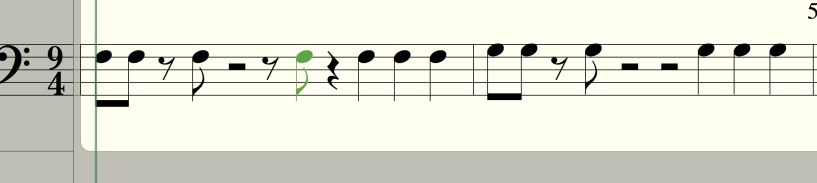
There ya go. Two notes. F and then G. That line ain’t gonna change for the whole song.
This brings me to the next aspect of creating this song, which was to fill in some of the chords. A while ago, when the Tumble Science Podcast for Kids was making an episode about space, I started designing an instrument using the Alchemy synthesizer, which comes built in with Logic. If you’re a Logic user and you haven’t played with Alchemy, then holy shit you’re missing out. Go find yourself some tutorials and get to work on that thing.
Anyway, Alchemy has this awesome feature where you can edit a sound by drawing an image in what they call the spectral editor. As far as I can tell, it basically manipulates the overtones in a given tone–amplifying them according to the brightness of the image. When using this editor, you have the ability not only to draw in the overtones you want to hear, but to import from just about any grayscale PNG image you can find anywhere. For funsies, I went and found a drawing of the milky way–you know, so you could hear the sound of space–and imported it into alchemy. This is what that looked like in Alchemy:

And this is what it sounded like, after I added a few organ-like sounding synth elements to the sound, and had it play the chords along with the bass line:
Ok. So now that I had something of a foundation (I mean, I’d add a bunch of other synth elements), I needed to come up with a melody.
Returning to my Fleetwood Mac source material, one of the things I think makes that song so interesting despite the incredibly simple harmonies is the way in which Stevie Nicks’ melody dances around the chords, using a fairly simple scale that actually has nothing to do with either chord, despite containing some chord tones common to both.
To make that highly-technical paragraph a little more concrete, the melody in “Dreams” is largely built off an A-minor pentatonic (or five-note) scale. Which looks like:
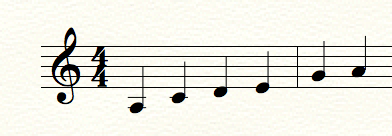
For those of you who know your chord theory, you can see that this scale contains the third and fifth from the F chord, and the fifth and root from the G. But it also contains the major 7th from the F–which, if we’re thinking like jazz guys is solidly a chord tone but if we’re thinking like pop music sounds a touch crunchy, especially if played in a prominent position. And it’s got an 11th and a 9th from the G.
Pentatonic scale melodies are easily the most common and–one might say–elemental types of melody in music. We all learn what a pentatonic melody is and what it sounds like at a very, very young age, and we become so used to hearing them that any new pentatonic melody sounds familiar to us even if we’ve never heard it before in our lives. Hence the inherent “catchiness” of the pentatonic scale.
By combining a pentatonic melody with an unrelated chord progression, though, you combine the familiarity of the pentatonic scale with the unfamiliarity of relatively unusual notes being sung against a simple chord progression. So even if the melody includes relatively dissonant intervals like an 11th and a 9th, it’ll still sound pretty good to our ears.
So, again, inspired by Fleetwood Mac, I began with this melody in one of Logic’s built in classic electronic piano sounds, which I ended up using in the chorus:

Which sounds like:
I kinda wanted this particularly melody to feel a touch behind the beat, so that it felt like it was moving a little out of time. Logic has done its best to figure out how to transcribe what I played, but all of those sixteenth notes are actually even a little bit later than they’re notated here.
So at this point, I’m starting to actually think about writing lyrics. At this point, the song is starting to take shape as something dreamy, maybe a touch wistful and sad but also expressing a degree of contentment. The chords going back and forth but not really having a strong pull in any direction remind me of a feeling of domestic contentment–maybe those feelings you have when it’s cold and rainy outside but you have a warm pair of slippers on and don’t need to go outside.
This made me to start to think about my life over the past year. After fifteen years living in Austin, and having developed a close group of very dear friends, and having spent years building a small career teaching music in a private school full of parents and students that I adored, I left. And I went someplace new and very different, with my wife and our son.
So I wrote a song about why I made that choice. And that’s what you’re hearing here!
 Marshall Escamilla