So one of the things I wanted to do for this little online music theory course I’m coming up with is to create a playlist that goes along with each of the themes we’re talking about here. It’s taken me a little bit, I managed to get one together for the latest theme.
So, let me begin by saying that I’m pretty proud of creating a playlist that manages to include Smash Mouth, Adele, Beethoven, and John Coltrane all at once. Yes, I did that. Surprisingly, it holds together pretty well as listening material, as long as you’re cool with pretty jarring shifts in genre.
Anyway, let’s talk about these songs. I picked out each of them because, in my opinion, they’re good examples of either disjunct, conjunct, or static melodic writing.
Our Conjunct Friends
The first few tracks are all examples of smooth, primarily conjunct melodies. The melody line stays fairly well-connected, rarely skipping much. Oddly, after I landed on including “All Star” and “Someone Like You,” I ended up coming to the conclusion that both melodies are remarkably similar. Take a look:

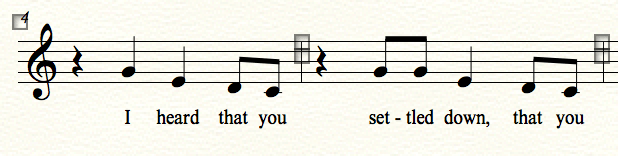
They both begin roughly with that disjunct skip from a G, followed by a conjunct step down to a C. I mean, that’s more or less where the similarities end, besides the fact that the two melodies pretty much always stay within the space from C to G, and the skips are all following what we in the music theory biz call the pentatonic scale.
The next two pieces are by everyone’s favorite late 18th-century Austrian composers, Mozart and Beethoven respectively. The Beethoven is from his 9th symphony, and contains the Ode to Joy melody that you probably learned at some point if you ever took piano lessons. The Mozart piece (“Der Vögelfanger bin ich ja”) is about as melodically simple as Mozart ever gets. A funny story about that piece: the actor who originally played the part of Papageno wasn’t actually a singer but rather a comedian. Mozart made his parts simple and easy to sing so that he could handle them.
“You Can Call Me Al” by Paul Simon is similarly smooth, and well connected, even though Simon manages to spit out like a thousand words a minute throughout. His speak-singy style in this song actually makes it pretty hard to sing, despite the fact that the melody doesn’t really travel all that far.
The Pieces that Leap
“Giant Steps” is so called not because the melody leaps around–though it does–but because the bass line does. This is probably one of the most disjointed catchy melodies anyone could ever come up with–though maybe I’m alone in thinking that it’s catchy.
Though “Somewhere Over the Rainbow” does have lots of smooth, stepwise motion, the leaps in it are so large and characteristic in the melody (think here about the first two notes, which are really, really far apart), that I would feel pretty comfortable characterizing it as a primarily disjunct piece.
The same is true of “Somewhere” from West Side Story. Those first two notes are actually closer together than the first two notes from “Rainbow,” but not by much. For those of you who know and understand intervals, it’s a great song to help you remember what a minor 7th sounds like. In fact, I can’t hear a melodic leap of a minor 7th without singing the rest of this melody.
The next tune, another Mozart entry, was written for one of the more virtuosic singers in Mozart’s opera company. This particular aria is one of the most famous of Mozart’s compositional oevre, so if you haven’t heard it before, definitely check it out. The leaps here are really, really difficult to sing for a bunch of reasons, but mostly having to do with how god damn high they are.
Because I like things to make no sense, the next disjunct tune comes to us from the Vengaboys. The melody for the chorus–you know, “The Vengabus is coming, and everybody’s jumpin'”–is quite disjunct, featuring a rather prominent leap from a G to a C (if we transpose to C major).
The Pieces That Don’t Move
The first piece I actually thought of for this section of the playlist was from Purcell’s King Arthur–basically at this point a frozen giant comes alive and then sings this aria as he begins to thaw. It’s a really awesome piece, from a really awesome but underperformed composer. He uses the repeated notes in the melody to give the sense of shivering cold, an effect that IMHO works quite well.
“One Note Samba” is the next most obvious entry in this section. The whole melody of the A section is just a single note, and for those of you who don’t speak Portuguese the lyrics are all about how the song only has one note in the melody. So, you know. An obvious entry.
After that, I learned in my research that static melodies seem to be something of a trend nowadays. So the next two tracks–by Taylor Swift and Post Malone–both feature hooks that involve lengthy repetitions of a single note. I had no idea that pop was going in this direction. But I guess you learn something new every day.
The final entry is one of my own, which, you know, it’s my web page, so forgive me for that. The melody in the chorus, sung by the other versions of myself who aren’t the lead vocalists in this song, is really just one note repeated over and over again. Someday, I’ll talk about the harmonic reasons why this single melody repeated over and over works–at least, as well as it does here.
 Marshall Escamilla
